
Nitrile hydratase (NHase) catalyzes the hydration of adiponitrile to 5-cyanovaleramide (5-CVAM), a high-value intermediate for the herbicide azafenidin and the nylon-6 precursor caprolactam.
A research team led by Professor Changhai Liang previously discovered and engineered a nitrile hydratase (ReNHase) with high substrate selectivity for aliphatic dinitriles. By optimizing the RBS sequence, they achieved balanced expression of the α and β subunits, increasing specific activity nearly 12-fold (ChemBioChem 2024, 25, e202400526; Chinese Patent ZL 202310433598.2). However, this enhanced catalytic efficiency compromised regioselectivity, causing significant accumulation of the by-product adipamide.
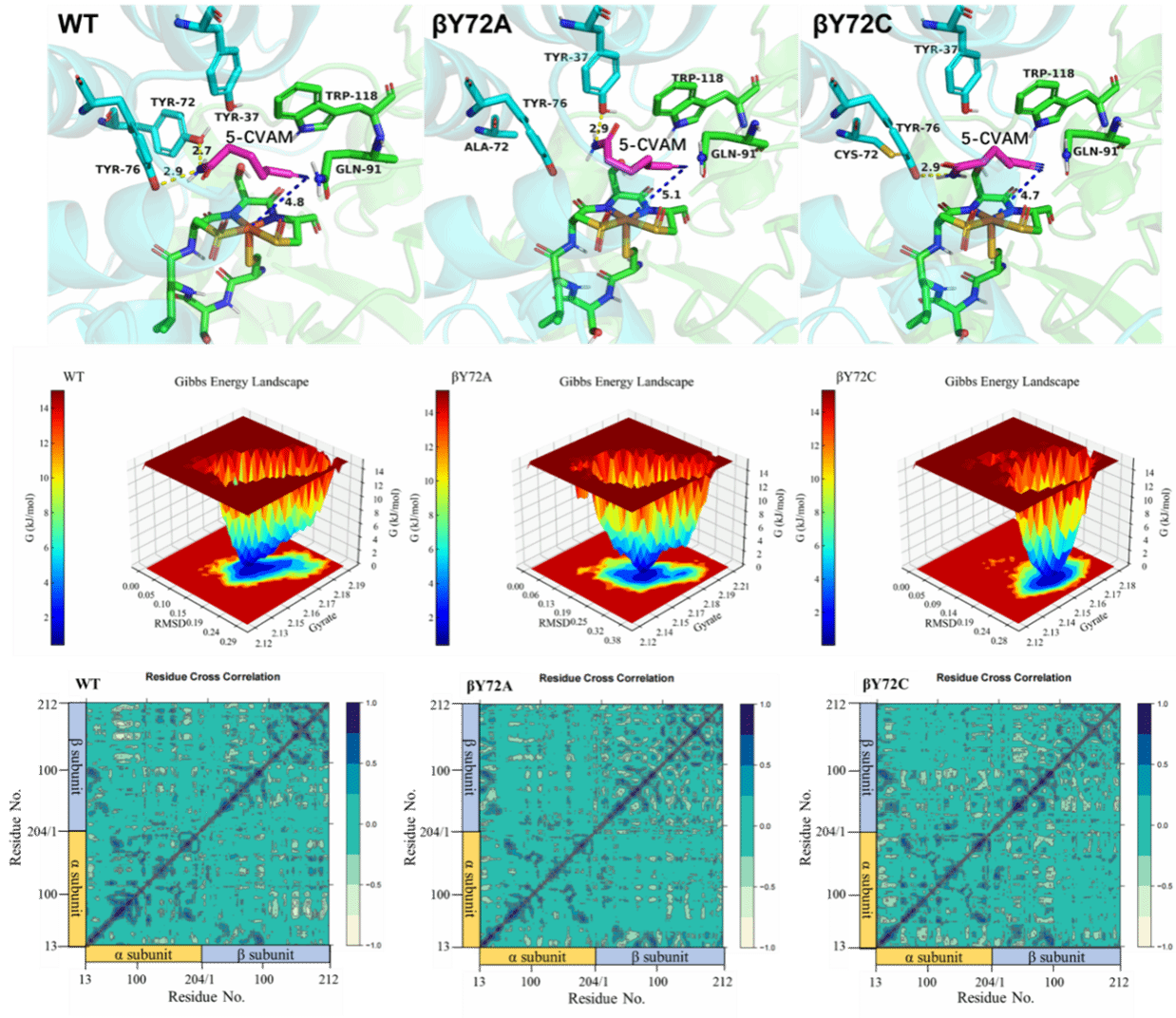
To address this, Professor Changhai Liang's group employed a semi-rational design strategy to target residues in the substrate channel and binding pocket of ReNHase. They constructed a mutant library and identified mutants that significantly suppressed by-product formation while enriching 5-CVAM. Kinetic characterization revealed βTyr72 as the key residue governing regioselectivity, yielding mutants βY72A and βY72C with 96% and 100% selectivity for 5-CVAM, respectively. Structural analysis, molecular docking, and dynamics simulations elucidated the mechanistic basis for this enhanced selectivity, showing that βTyr72 functions as a "switch" residue that coordinately regulates both regioselectivity and catalytic activity in ADN hydration.
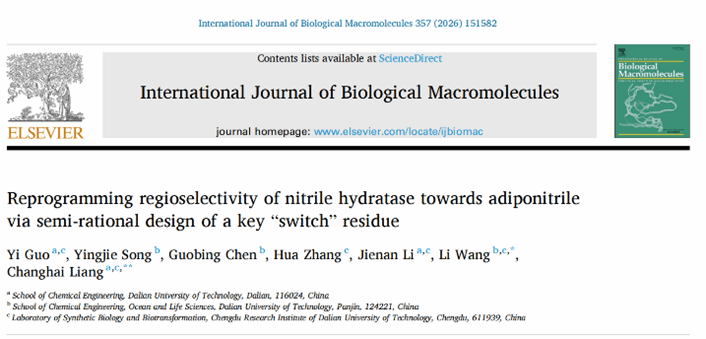
The findings were published in International Journal of Biological Macromolecules (IF: 8.5, CAS Q2, JCR Q1), with PhD student Yi Guo as first author, Professor Changhai Liang and Associate Professor Li Wang as corresponding authors. The relevant scale-up validation is currently underway at the Chengdu Research Institute of Dalian University of Technology.
Paper: https://doi.org/10.1016/j.ijbiomac.2026.151582
Published on 9 July 2026

Address: No.2 Dagong Road, Liaodong Bay New District, Panjin City, Liaoning Province, P.R.C., 124221
Tel: +86-427-2631925 +86-427-2631933
Email: pjdut@dlut.edu.cn
Fax: +86-427-2631928