

Zhenwei Lyu, a faculty member at the Leicester International Institute, Dalian University of Technology (DLI) has advanced tests of the strong equivalence principle using gravitational-wave observations, in collaboration with researchers from Chongqing University, the Institute of Mechanics of the Chinese Academy of Sciences, Peking University, Dalian University of Technology, The Hong Kong University of Science and Technology, and Zhengzhou University. The findings were published in Communications Physics, a Nature Portfolio journal, under the title “Testing the strong equivalence principle with multimessenger binary neutron star mergers.”
To address whether the gravitational constant varies over time, the team developed a unified waveform model that incorporates the effects of a time-varying on neutron star structure, binary dynamics, and gravitational-wave propagation across cosmological distances. They then performed a comprehensive multimessenger Bayesian analysis of the binary neutron star merger GW170817 and its electromagnetic counterpart, GRB 170817A.
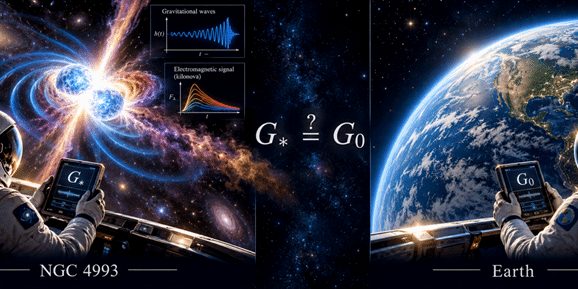
The strong equivalence principle is a cornerstone of general relativity. It implies that Newton’s gravitational constant, , does not vary with time or spatial location; testing whether changes over time is therefore an important way to search for new physics beyond general relativity. Observations from lunar laser ranging, pulsar timing, and the cosmic microwave background have already placed stringent constraints, but they primarily probe the weak-field or quasi-static regime. Testing the principle in strong-field, highly dynamical processes involving objects with strong self-gravity, such as neutron stars, remains a major challenge.
Gravitational waves offer a new observational window on this question. GW170817 was the first binary neutron star merger detected in both gravitational waves and electromagnetic radiation. Its associated gamma-ray burst, GRB 170817A, and subsequent multiwavelength observations provided independent information on the source’s distance, sky position, and orbital inclination. This information helps break degeneracies between these parameters and possible effects of new physics beyond general relativity, making the event an ideal opportunity to test the strong equivalence principle with real multimessenger data.
The team systematically accounted for the combined effects of a time-varying on both the generation and propagation of gravitational waves. At the source, changes in affect neutron star masses and the evolution of the binary orbit, leaving characteristic corrections in the gravitational-wave phase. By numerically solving the Tolman–Oppenheimer–Volkoff equations for different neutron star equations of state, the researchers determined how neutron star masses respond to changes in , improving the model’s self-consistency. For propagation, they derived corrections caused by a time-varying in a Friedmann–Lemaître–Robertson–Walker cosmological background. These corrections were incorporated into a single gravitational-wave template alongside the source-phase corrections, providing a unified description of the effects of a time-varying on neutron star structure, binary dynamics, and cosmological propagation.
Using this model, the team performed Bayesian parameter estimation on the GW170817 data recorded by the LIGO Hanford and Livingston detectors. They analyzed the data separately with the TaylorF2 and IMRPhenomXAS_NRTidalv2 waveform models to assess the robustness of the results, while also incorporating electromagnetic constraints from GRB 170817A and its follow-up observations. Neither waveform model showed a statistically significant departure from general relativity, and both yielded consistent constraints.
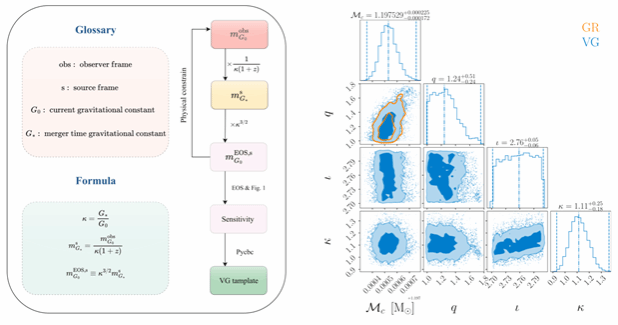
The team obtained a conservative 3σ3σ constraint on the fractional rate of change of the gravitational constant, ranging from −3.36×10⁻⁹−3.36×10⁻⁹ to 5.34×10⁻¹⁰yr−15.34×10⁻¹⁰ yr−1. This constrains any temporal variation to the order of one part in a billion per year and represents the tightest constraint currently obtained from actual gravitational-wave observations.
The study shows that multimessenger gravitational-wave observations can serve as a powerful tool not only for probing compact objects and cosmology but also for testing fundamental theories of gravity. As more multimessenger binary neutron star events are observed and third-generation gravitational-wave detectors come into operation, this method could further improve the precision of tests of a time-varying gravitational constant and other deviations from general relativity.
Figure 1. Joint analysis of gravitational-wave and gamma-ray-burst signals from NGC 4993, approximately 130 million light-years away. Comparing in the merger region with its value near Earth tests the strong equivalence principle.
Figure 2. Left: workflow for constructing gravitational-wave templates in a theory with a time-varying gravitational constant. Right: constraints on variation in from multimessenger observations, with posterior probability distributions.
Publication Details
Jie Zhu, Hanlin Song, Zhenwei Lyu, Hao Li, Peixiang Ji, Jun-Chen Wang, Haobo Yan, and Bo-Qiang Ma. “Testing the strong equivalence principle with multimessenger binary neutron star mergers.” Communications Physics (2026). DOI: https://doi.org/10.1038/s42005-026-02878-z
Jie Zhu and Hanlin Song are joint first authors. Hanlin Song, Zhenwei Lyu, Hao Li, and Bo-Qiang Ma are corresponding authors.
Published on 3 November 2026

Address: No.2 Dagong Road, Liaodong Bay New District, Panjin City, Liaoning Province, P.R.C., 124221
Tel: +86-427-2631925 +86-427-2631933
Email: pjdut@dlut.edu.cn
Fax: +86-427-2631928