

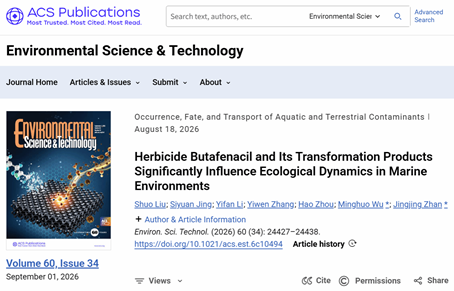
Recently, relying on a key campus-supported platform for the Development of Characteristic Directions in Marine Disciplines, the “Marine Ecological Security and Sustainable Development” research team led by Prof. Jingjing Zhan of the School of Chemical Engineering, Ocean and Life Sciences has made important progress in assessing the ecological impact of herbicides on marine phytoplankton. The findings, entitled “Herbicide Butafenacil and Its Transformation Products Significantly Influence Ecological Dynamics in Marine Environments,” have been published in the renowned journal Environmental Science & Technology.
Herbicides are widely used in modern agricultural production. Their residues can enter the ocean via surface runoff, thereby affecting the growth and community structure of phytoplankton, the primary producers in marine ecosystems. However, studies on the environmental behavior and ecological consequences of such pollutants after they enter marine environments remain quite limited. To address this gap, the research team focused on butafenacil (BFA), a widely used protoporphyrinogen oxidase (PPO)-inhibiting herbicide, and conducted systematic research using microalgae. The results reveal that BFA is extremely toxic to marine microalgae, and that its transformation products (TPs) can continuously affect the community structure and ecological balance of marine microalgae.
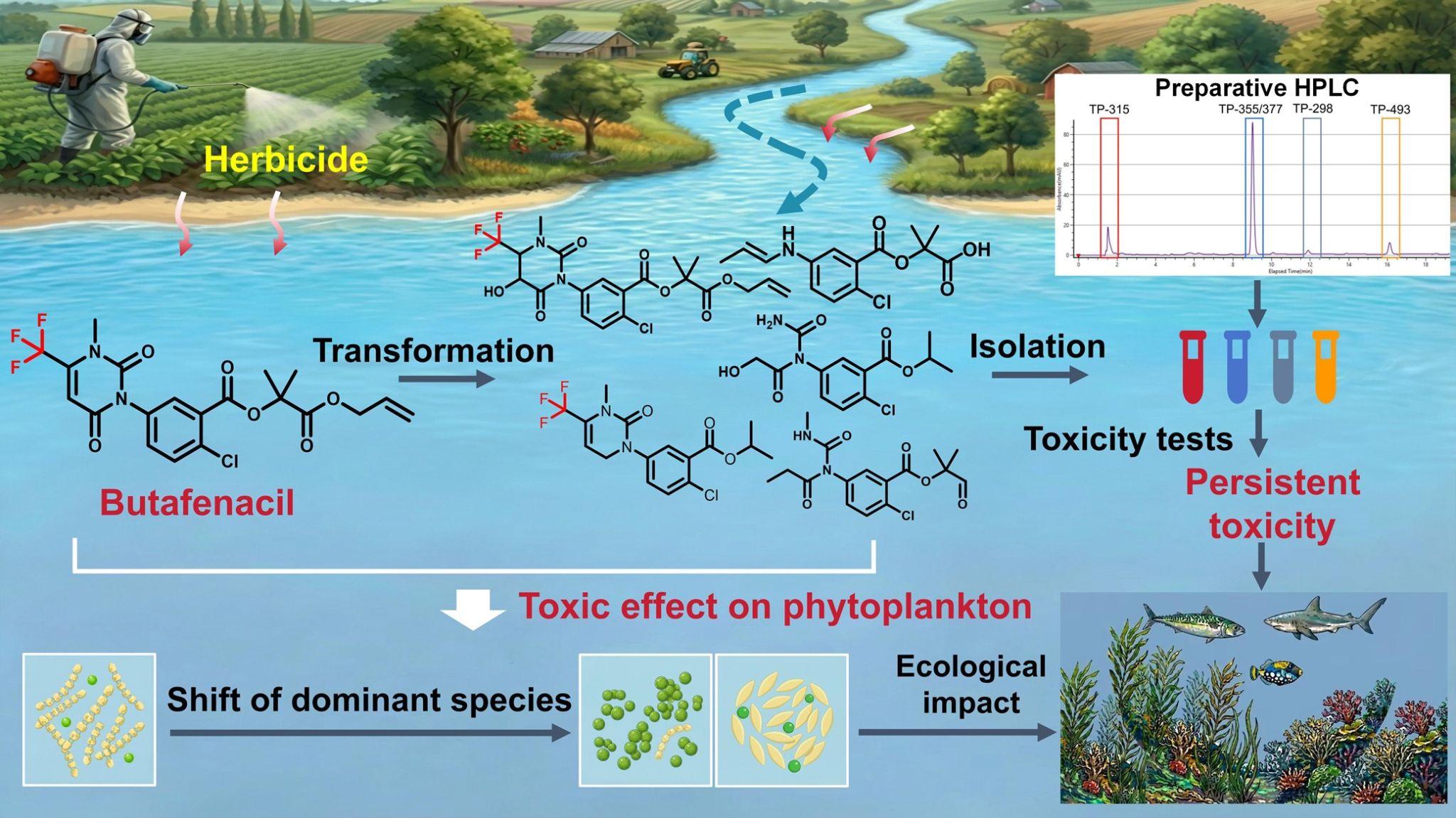
This study shows that BFA exerts toxic effects on the marine diatom Skeletonema costatum and the green alga Chlorella sp. at concentrations as low as approximately 1 μg/L. BFA exposure can markedly strengthen the competitive advantage of Chlorella sp. and trigger a shift in the dominant microalgal population from other algal species to Chlorella sp. Using non-targeted analysis combining solid-phase extraction and liquid chromatography–high-resolution tandem mass spectrometry, the research team identified 16 BFA transformation products in BFA-impacted seawater, 13 of which were newly discovered. Through predictive computational toxicology, preparative liquid chromatography for separation and purification, and algal toxicity bioassays, the study verified that most TPs retain high biological toxicity, and that some products (e.g., TP 298) are even more toxic than the parent molecule.
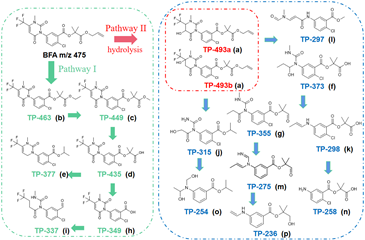
These findings challenge the conventional hypothesis that cleavage of the trifluoromethyl group of a pollutant leads to detoxification, elucidate the intrinsic cause of persistent ecotoxicity after degradation of the parent compound, and fully demonstrate the necessity of conducting ecological risk assessments for pollutant TPs.
This research was supported by the Fundamental Research Funds for the Central Universities and the National Natural Science Foundation of China.
Paper DOI:https://doi.org/10.1021/acs.est.6c10494
Published on 16 September 2026

Address: No.2 Dagong Road, Liaodong Bay New District, Panjin City, Liaoning Province, P.R.C., 124221
Tel: +86-427-2631925 +86-427-2631933
Email: pjdut@dlut.edu.cn
Fax: +86-427-2631928